Signal names that travel
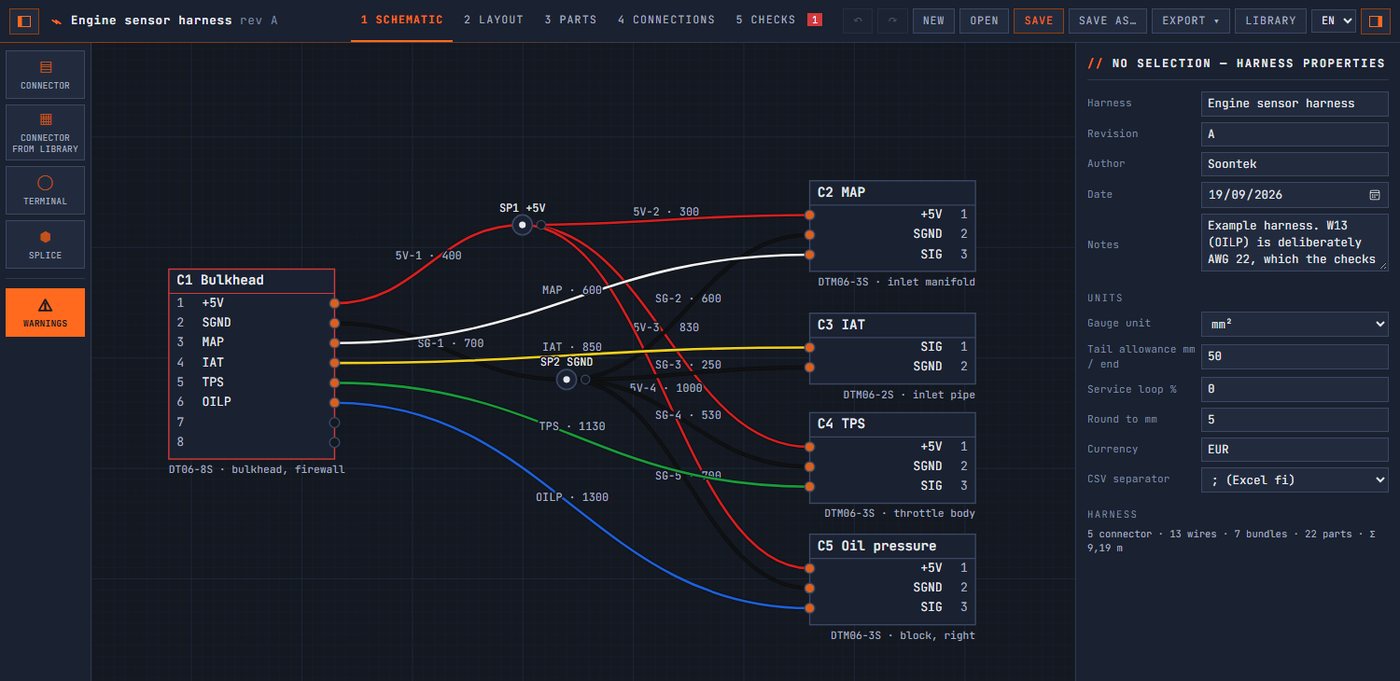
A name belongs to the net, not to one pin. Type it once and it follows every connected pin and wire. If two names meet, the tool asks which one stays.

Harness design tool
A wiring harness designed in your browser. Schematic, dimensioned layout, bill of materials, cut list and a full-size form board, all from one document that checks itself.
The problem
A wiring harness is usually documented in whatever was at hand. The cut list is a spreadsheet, the schematic is a drawing package, the form board is paper on a bench. Nothing checks that the three agree, and nothing carries forward to the next revision.
Subscription tools solve part of that, and then the drawings live on someone else's server, behind someone else's licence renewal.
Tour
Every view reads the same document. Move a wire in the schematic and the cut list, the checks and the form board already know.
Place connectors from the library, join cavities with wires and splices, and name signals straight on the drawing. Wire sizes show in mm² and AWG side by side.
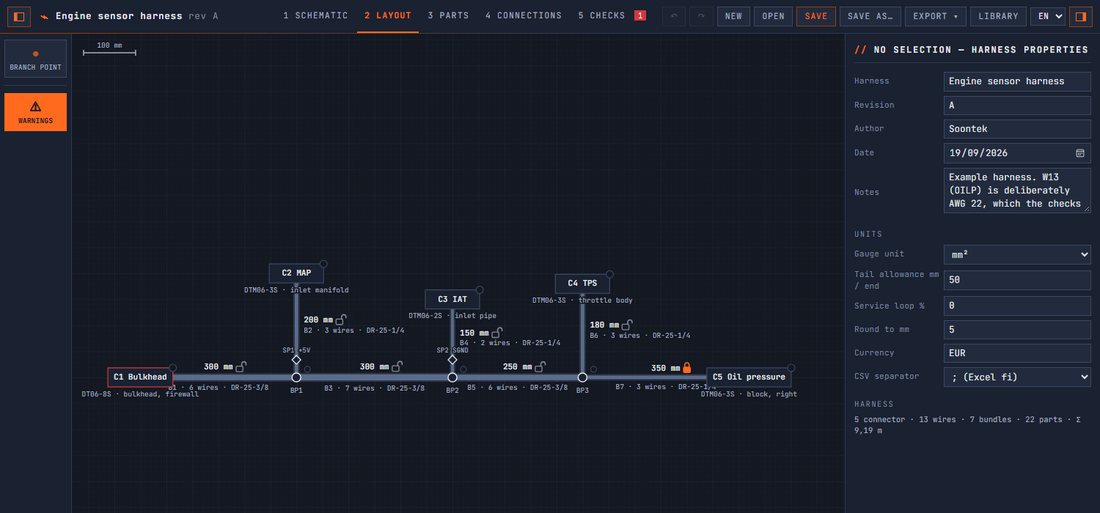
The same harness as a routed tree: branch points, bundle lengths and dimensions you can lock. Wire lengths follow the route, with tail allowance and service loop added.
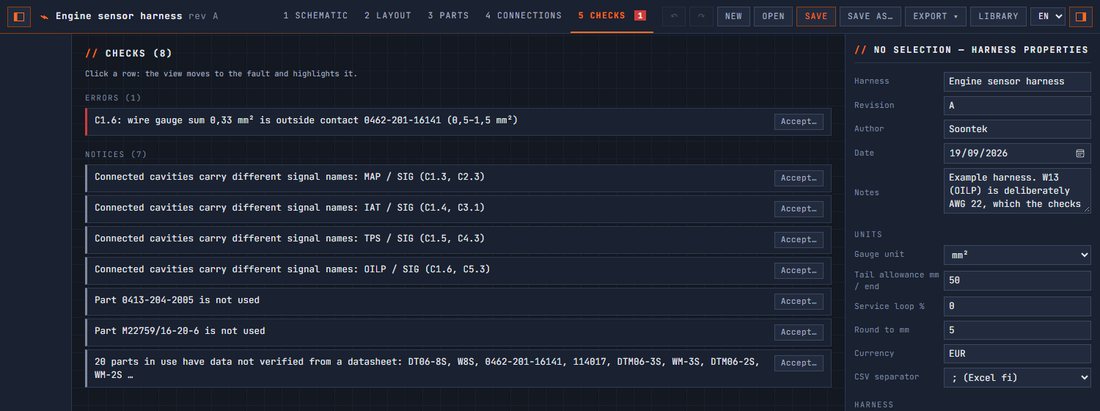
Wire gauge against the contact's range, signal names that disagree, parts left unused, library data not yet verified. Click a row and the view moves onto the fault.
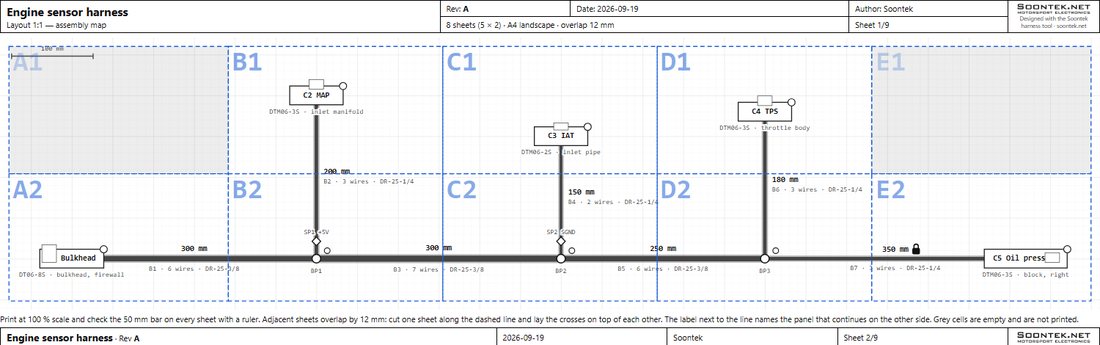
Bill of materials, cut list, connection table and the form board at full size. Here the assembly map: eight A4 sheets, 12 mm overlap, alignment crosses on every seam.
Features
Each of these exists because a real harness needed it.
A name belongs to the net, not to one pin. Type it once and it follows every connected pin and wire. If two names meet, the tool asks which one stays.
Accept a finding with a reason and it stops warning. It does not disappear: it stays in the file, on the element, and on its own sheet of the printout.
When the layout will not fit the sheet it splits into overlapping panels with alignment crosses. Empty panels are skipped, an assembly map prints first, and a 50 mm bar on every sheet lets you check the print scale with a ruler.
The connections are already in a spreadsheet? Bring in .xlsx, CSV or pasted cells. Columns are read from the headings, a preview shows the result first, and the whole import is one step you can undo.
Twist two to four wires together. The pair is marked in the schematic and the tables, and the extra length the twist takes is already in the cut length.
Where the wire diameters are known, the tool works out the bundle diameter and lists the DR-25 sleeve and the boot that fit. A sleeve that will not fit is flagged.
Deutsch DT and Autosport, Junior Power Timer, AMPSEAL, Metri-Pack, Superseal, Sumitomo 090, wire, ring terminals, splices, SolderSleeve and DR-25. Search takes wildcards, and any part not yet verified from a datasheet is marked as such.
Every harness keeps its saved versions and any of them can be restored. Separate harnesses link through a shared connector, and the checks compare the pins on both sides.
Open the same harness in two windows and a change in one shows in the other at once. A save made from a stale copy is refused instead of overwriting newer work.
For hobbyists
Not everything has to be commercial or turn a profit. Some things are worth doing simply because they are good for everyone who builds.
Building for yourself? The whole tool is yours: every view, every printout, as many harnesses as you like. No trial clock, no locked features, no invoice.
Share a harness you have drawn, and the next builder starts from something real instead of an empty page. Nobody has to. It is simply how this gets better for everyone.
This tool is twenty years of experience turned into software. If you would like to chip in towards what it costs to keep it running, that is welcome and appreciated. It is never expected.
Ask for a hobby account Write a line about what you are building and we will set you up.
Technical
No framework, no package manager, no cloud account. The whole tool is code we wrote and can hand over.
| Runs in | Any current browser. Nothing to install on the workstation. |
|---|---|
| Server | Python standard library only. No external service and no third-party account. |
| Output | Print and PDF, SVG, CSV and JSON. |
| Import | Excel (.xlsx), CSV, or cells pasted from a spreadsheet. |
| File format | Open JSON, documented, version 6. Files from earlier versions open as they are. |
| Part library | 1,389 parts, 1,095 verified against manufacturer documents. The rest are marked unverified. |
| Versions | 20 saved versions per harness, restore any of them. |
| Accounts | Other users see a harness only when its owner shares it. The Soontek administrator can view harnesses but not change them (privacy policy). |
| Language | Interface and built-in guide in English and Finnish. |
| Marking | Drawings carry a mark showing which tool produced them. |
Running, in daily use
The tool is in daily use at Soontek and runs on our own server. Hobbyists use it free of charge: get in touch and we will set up an account.
For commercial work it is not a shelf product yet: the licence terms are still being settled and the part library is being verified one range at a time. Tell us what you build and we will agree how - on our server with your own account, or as a copy that runs on your machine.
Ask about it
Tell us what you build and how many harnesses a year. We will tell you whether this is worth your time. Building for yourself? Just say so, and it is yours to use.
info@soontek.net